

Catering Insurance Quote: Real 2026 Costs, Coverage, and How to Get One Fast
A catering insurance quote in 2026 usually falls between $50 and $300 a month for general liability alone, or $125 to $300 a month for a full package with property, workers comp, and auto. Your real price depends on your state, your staff count, alcohol service, and how many events you run each year. Get quotes from three carriers before you pick one.
Table of Contents
Quick Answer: Catering Insurance Cost and Coverage at a Glance
Here is the short version, so you do not have to scroll to find it.
| Coverage | Typical monthly cost 2026 |
|---|---|
| General liability | $42 to $89 |
| Business owners policy (BOP) | $81 to $99 |
| Workers compensation | $69 to $90 |
| Commercial auto | $150 to $250 |
| Liquor liability | $50 to $65 |
| Full bundle for a staffed caterer | $125 to $300 |
Most solo caterers with no staff can get a basic catering liability insurance quote for under $100 a month. Full service caterers with vans, alcohol, and a crew often land in the $250 to $500 a month range once every policy is stacked together.
There is no single federal law that forces every caterer to carry insurance. But workers compensation is required in almost every state once you hire even one part time server, and commercial auto is required in every state for any van or truck owned by the business. On top of that, nearly every venue and event planner will ask for proof of general liability before they let you work.
What Is Catering Insurance (and What a Quote Actually Includes)?
Catering insurance is not one single policy. It is a small stack of separate policies bundled together to match how you actually cook, drive, staff, and serve.

When you ask for a catering insurance quote, you are really asking an underwriter to price several risks at once. Those risks include a guest getting hurt at an event, a piece of gear breaking on the way to a venue, an employee getting injured while carrying a hot tray, and a claim that your food made someone sick.
A real quote usually pulls together some combination of:
- General liability insurance for caterers, which covers third party injury and property damage
- Product liability, sometimes called products and completed operations, which responds if your food is blamed for illness
- Commercial property or a business owners policy (BOP) for caterers
- Commercial auto insurance for caterers if you own vans or trucks
- Workers compensation catering business coverage once you have employees
- Liquor liability insurance catering if alcohol is served at your events
- Equipment coverage for chafing dishes, tents, and hot boxes that travel with you
A quote is simply the price and terms an insurer offers once they know your revenue, your staff size, your states of operation, and whether you serve alcohol. Change any one of those inputs and the number moves.
How Much Does Catering Insurance Cost in 2026?
How much does catering insurance cost is the single most searched question on this topic, so here is the honest answer with real ranges instead of one flat number.
Across 2026 industry pricing data, catering business insurance runs anywhere from $34 to $326 a month depending on the policy mix, with most active caterers landing between $125 and $300 a month once they combine general liability, property, and workers comp into one package. A bare bones solo operation with no staff and no alcohol can often stay under $100 a month.
Average Catering Insurance Cost by Coverage Type
General liability tends to average around $89 a month nationally, though it can run as low as $76 in lower cost states and as high as $111 in higher cost states like Hawaii. Workers compensation averages around $74 to $90 a month but swings by state, since North Carolina rates land far below New York rates for the same crew size. A full BOP that bundles liability and property together averages around $99 a month.
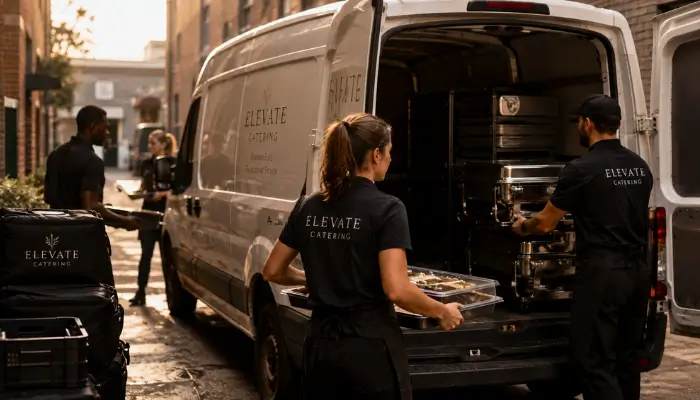
Commercial auto is usually the most expensive single line item for a mobile caterer, since it prices the vans, the miles driven, and the gear riding inside them. Liquor liability is one of the cheaper add ons by itself, but it can raise your total bill more than any other single choice, because alcohol claims tend to be severe.
Catering Insurance Cost by Business Type
A catering business insurance cost per month is not the same for every operator, so here is how it breaks down by setup.
A home-based catering insurance quote for a solo baker or small kitchen operation usually stays in the $50 to $150 a month range, mostly general liability plus a small property endorsement. A catering insurance quote for LLC structures is priced the same way as a sole proprietor policy. Your business structure does not change the underwriting much, your revenue, staff, and risk exposure do.
A catering insurance quote for food truck or mobile unit runs higher because commercial auto gets added to the stack, often pushing the total to $200 to $400 a month once the vehicle is factored in. A self-employed caterer insurance quote with zero staff and no vehicle is usually the cheapest version of this coverage, sometimes under $60 a month for basic general liability.
I Need Insurance for My Catering Business, How Much Should It Cost Me?
If you are a new caterer asking this exact question, here is a fair rule of thumb for 2026. Budget $75 to $150 a month if you work solo, cook from a licensed kitchen, and do not serve alcohol. Budget $200 to $350 a month if you have one or two part time staff and a van. Budget $400 or more a month once you add a full crew, an open bar option, and multiple vehicles.
These numbers assume standard limits of $1 million per occurrence and $2 million aggregate, which is what most venues ask for. If a client wants higher limits for a large wedding or corporate event, expect your price to move up slightly, not double.
The smartest move before you buy anything is to write down exactly what you do in a normal month. List your staff count, your vehicles, whether you pour alcohol, and where you cook. That single page will get you a faster and more accurate instant catering insurance quote than calling around with vague details.
What Coverages Are Included in Catering Insurance?
Here is a clear breakdown of what each piece actually protects, since this is where most buyers get confused.
General liability pays for third party bodily injury and property damage. A guest slips near your buffet table or a staff member scorches a venue’s countertop while setting up chafing dishes. This is the policy almost every contract requires first.
Product liability, often bundled inside general liability as products and completed operations, is the piece that responds to a foodborne illness claim. This matters more than people think. Catering and banquet events have historically made up a real share of reported foodborne illness outbreaks in the United States, which is exactly why venues insist on this coverage before they let you cook on site.
Commercial property or a BOP covers your kitchen equipment, inventory, and the space you rent or own. Food spoilage insurance falls under this category and covers the cost when a freezer fails or a power outage ruins your ingredients before an event.
Equipment breakdown coverage for a caterer protects the machines that keep your business running, ovens, refrigeration units, and mixers, if they break down from an internal mechanical or electrical cause rather than a fire or storm.
Commercial auto covers any vehicle titled to the business. Personal auto insurance almost always excludes business use, so a van full of food and gear needs its own commercial policy.
Workers compensation covers medical bills and lost wages if an employee gets hurt on the job, including part-time event staff hired for a single weekend. For a little workplace motivation at the end of the week, friday inspirational quotes for work can also help teams finish the week with a positive mindset.
Liquor liability covers claims tied to alcohol service, which matter because most states hold servers legally responsible under dram shop laws if an overserved guest causes harm after leaving your event.
Coverage that people forget until it is too late includes inland marine or equipment in transit coverage, which protects tents, hot boxes, and chafing dishes while they ride in your van or sit unattended at a venue overnight. Standard property policies are often weak here, exactly where a caterer’s real risk lives.
Why You See Too Good to Be True Pricing Online
If you have searched around and seen ads promising a catering insurance quote online for $19 a month, here is what is usually happening behind that number.
Rock bottom prices almost always describe the absolute minimum general liability limit, often $500,000 instead of the $1 million most venues actually require. Some ads also price a policy with no products and completed operations coverage attached. which means a foodborne illness claim would not be covered at all. Others quote a policy before workers compensation, auto, or liquor liability is added, then surprise buyers with the real total once those pieces are included.
A genuinely cheap catering insurance quote is possible, but it should still include food related liability and match the limits your venues ask for. If a price looks far below every other quote you received, ask the agent directly what limit is attached and whether food illness claims are covered before you sign anything.
Is Catering Insurance Required by Law?
The honest answer is mixed, and this is one of the most misunderstood parts of the whole topic.
Workers compensation is legally required in nearly every state once a caterer has even one employee, including part time event staff. Commercial auto insurance is legally required in every state for any vehicle titled to the business.
General liability is rarely required by state law itself, but it is almost always required by contract, since venues, event planners, and corporate clients will not let you work without proof of coverage and a certificate of insurance.
State by State Snapshot
California requires workers compensation the moment you hire your first employee, with no size exception, and most venues additionally demand $1 million in general liability before booking.
Texas is one of the few states where private employers can legally skip workers compensation, though doing so trades a small premium savings for open ended legal exposure if a staff member gets hurt.
Florida generally follows the same pattern as most states, workers comp becomes mandatory once you cross a small employee threshold, and commercial auto is required for any business owned vehicle.
New York requires workers compensation and commercial auto by law, and most banquet halls and event spaces will not sign a contract without a certificate showing general liability limits as well.
Search catering insurance quote California, catering insurance quote Texas, or your own state alongside the phrase before you buy, since local rules and average pricing shift enough to matter.
Does Homeowners Insurance Cover a Home Based Catering Business?
No. This is one of the most common and most costly misunderstandings among new caterers. Standard homeowners and renters policies specifically exclude business activity and business property, even if you only bake out of your own kitchen a few times a month.
If a client claims your home prepared food made them sick, or your oven catches fire while making a large order, your homeowners insurer can deny the claim entirely once they learn business use was involved and was never disclosed.
A home-based catering insurance quote for a small commercial general liability policy usually costs far less than most new caterers expect, often starting around $50 to $75 a month, which is a small price for real protection.
Catering Insurance for Different Situations
One Day and Event Catering Insurance
A one day catering insurance quote or short term catering insurance quote is built for caterers who only need coverage for a single wedding, Happy birthday quotes, or corporate event rather than a full year.
Basic one day coverage for a low risk event often starts around $50 to $100, moving toward $150 to $300 as guest count, alcohol, and on site cooking hazards increase.
Wedding Catering Insurance
A wedding catering insurance quote almost always needs to satisfy the venue’s contract, which usually asks for $1 million per occurrence and $2 million aggregate general liability.

Plus your business named as the insured party and the venue added as an additional insured. If a bar is part of the package, liquor liability gets added too.
Food Truck and Mobile Catering Insurance
A mobile catering insurance quote differs from a standard catering policy mainly because of the vehicle. Commercial auto becomes mandatory rather than optional, and insurers look closely at how many miles you drive and how much gear rides inside the truck overnight, since theft and transit damage are common claims for this group.
Self Employed and No Employee Caterers
A catering insurance quote no employees is usually the simplest and cheapest version to buy, since there is no workers compensation requirement to layer in. A self-employed caterer insurance quote still needs general liability and product liability at minimum, because clients and venues do not care whether you have staff, they care whether you carry coverage.
Certificate of Insurance: What Venues Actually Want
A certificate of insurance, often shortened to COI, is the one page proof of coverage a venue asks for before your event. Most venues want to see general liability limits of at least $1 million per occurrence and $2 million aggregate, your business listed as the named insured, and the venue itself listed as an additional insured on the policy.
Ask your insurer how fast they can issue a COI and whether additional insured requests cost extra. Slow paperwork has cost real caterers real bookings, so this is worth confirming before you buy, not after you need one urgently.
How to Get a Catering Insurance Quote Fast
Getting a clean catering insurance quote for small business owners does not have to take all day. Follow these steps in order.
First, write down your annual revenue, your staff count including part time event help, and every vehicle titled to the business. Second, decide whether alcohol will ever be part of your service, even occasionally, since this changes the quote significantly. Third, note your state and city.

since local requirements affect both price and legal minimums. Fourth, request quotes from at least three sources so you can compare limits side by side rather than price alone. Fifth, confirm that products and completed operations coverage is included, since this is the piece that protects you from food related claims specifically.
Doing this before you call or apply online usually turns a confusing back and forth into a catering insurance quote online that lands in your inbox the same day.
Catering Insurance Quote Comparison: What to Look at Beyond Price
A catering insurance quote comparison should never start and end with the monthly number. Two quotes at the same price can carry very different real world protection.
Check whether products and completed operations coverage is included, not just general liability. Check whether equipment in transit or inland marine coverage is part of the package, since this covers gear stolen or damaged away from your home base, a gap that catches many caterers off guard. Check how fast the insurer issues a certificate of insurance and whether adding an additional insured costs extra. Finally, check the deductible, since a lower monthly price sometimes hides a much higher deductible that gets triggered the moment you file a real claim.
Common Mistakes That Cost Caterers Money
The most common and expensive mistake is assuming a commissary kitchen’s insurance covers your business too. It almost never does. That policy protects the building, not your equipment, your staff, or your liability.
The second common mistake is running catering deliveries through a personal auto policy. Personal auto specifically excludes business use, and a claim can be denied entirely once the insurer learns the vehicle was being used commercially at the time.
The third mistake is buying only host liquor coverage when you are actually selling and serving alcohol directly, which requires true liquor liability instead.
Bottom Line
A catering insurance quote is not one number, it is a reflection of exactly how you run your business, your staff, your vehicles, and whether alcohol is part of the event. Solo caterers can often stay under $100 a month, while full service operations should expect $250 to $500 once every policy is combined.
Before you buy anything, write down your real operation, get three quotes, and confirm that food related liability is actually included in the price you were quoted. That single habit will save more money than chasing the lowest number on a search results page.
This guide is for general information only and is not legal or insurance advice. Talk with a licensed insurance agent in your state before you buy a policy.
Frequently Asked Questions
How much is catering insurance?
Most solo caterers pay $50 to $150 a month for basic coverage, while full staffed operations with vehicles and alcohol often pay $250 to $500 a month.
Do I need insurance to cater food?
Almost every venue, event planner, and corporate client will require proof of general liability insurance before they let you work, even where state law does not technically require it.
What does catering insurance cover?
It typically covers third party injury, property damage, food related illness claims, equipment, vehicles, and employee injuries, depending on which policies you bundle together.
How much liability insurance for catering?
Most venues ask for $1 million per occurrence and $2 million aggregate in general liability, which is the standard limit most caterers should carry regardless of business size.
What is the cheapest catering insurance?
The cheapest option is usually a solo caterer with no employees, no vehicle, and no alcohol service, buying general liability with product liability included.