

Bedtime Prayer for Kids to Overcome Nighttime Fear
A bedtime prayer for kids to overcome nighttime fear is a short, spoken prayer that helps a child feel safe before sleep by reminding them that God is near, watching over them, and stronger than anything hiding in the dark.
Saying it out loud, every night, in the same calm voice, turns it into a habit the child’s mind learns to trust — and that trust is what actually chases the fear away, not the words themselves. Below you’ll find short prayers for different fears (the dark, nightmares, sleeping alone), Bible verses to go with them, and a few real ways to build this into your child’s night.
Why Do Kids Get Scared at Night?
A child’s imagination doesn’t switch off just because the lights do. During the day, there’s noise, movement, people around — enough going on that small worries get pushed to the back. At night, all of that disappears. The room goes quiet, the shadows get bigger, and every creak in the house suddenly sounds like something with a heartbeat.
This isn’t your child being dramatic. It’s how a developing brain works. Kids between about 2 and 7 go through a stage where they can’t fully separate “imagined” from “real” yet, which is exactly why a shadow on the wall can become a monster in under a second. Add a scary cartoon, a loud storm, or a change in routine — a new bedroom, a new school, a new sibling — and that fear gets louder.
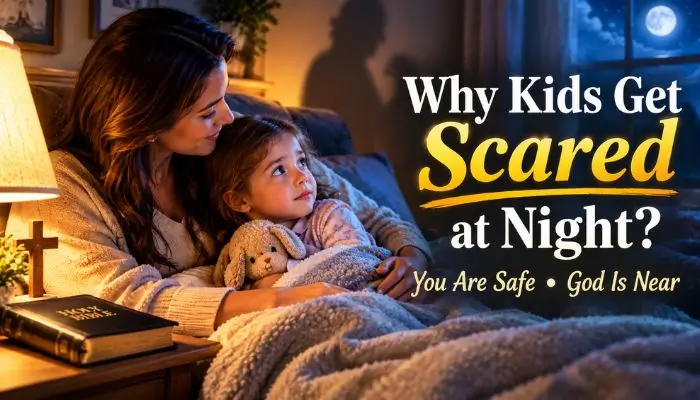
The good news: this stage passes. And a prayer, said the same way every night, gives a child something steady to hold onto while it does.
It also tends to arrive in waves rather than a single straight line. A toddler might be perfectly fine with the dark for months, then suddenly start asking for the hallway light after watching one slightly-too-scary movie.
A seven-year-old who slept fine for years might start struggling again after a move, a new sibling, or even just hearing a scary story from a friend at school. That’s normal too — fear at this age comes and goes with whatever’s new in a child’s world, not on a fixed schedule.
Why a Bedtime Prayer Helps a Child Feel Safe
A prayer works differently than “there’s no monster under the bed.” Telling a child their fear isn’t real rarely helps — because to them, right then, it is real. A prayer doesn’t argue with the fear. It gives the child something bigger to stand behind.

When a child prays, three things happen at once:
- They put the fear into words. Naming a fear out loud already makes it smaller.
- They hand it to someone stronger. A child can’t fight off “the dark,” but they believe God can — and that belief is enough to let them relax.
- They get a routine their body recognizes. The same words, the same order, every night, tells their nervous system: this is the safe part of the day. You can rest now.
This is also why the prayer for protection and guidance works well for adults facing uncertainty — the same principle, that naming a fear to God takes weight off it, applies just as much to a five-year-old worried about the dark as it does to a grown adult worried about tomorrow.
How to Stop a Child From Being Scared at Night?
Prayer works best alongside a few small habits, not instead of them. Here’s what actually helps, in the order most parents find works:
1. Build a Calm Bedtime Routine
Kids relax when they know what’s coming next. Bath, pajamas, story, prayer, lights out — same order, same time, every night. The predictability itself is calming, before the prayer even starts.
2. Keep a Nightlight or a Comfort Object Nearby
A soft nightlight, a favorite stuffed animal, or a blanket that smells like home gives a child something physical to hold onto when you leave the room. It’s a small thing, but it matters more than most parents expect.
3. Let Them Talk About the Fear Before You Pray
Ask “what’s scaring you tonight?” before jumping into the prayer. Sometimes it’s the dark. Sometimes it’s a dream from last week. Sometimes it’s something they overheard and don’t understand. Naming it first makes the prayer that follows feel like it’s actually answering something, not just a routine to get through.
4. Always End the Night With a Prayer — Not Just on the Hard Nights
If prayer only shows up when a child is already scared, they start to associate it with fear. Say it every night, scared or not, so it becomes part of “going to bed” rather than an emergency response.
5. Keep Your Own Voice Calm
Kids read tone faster than words. A rushed or tired “just go to sleep” undoes a lot of what the prayer is trying to do. A slow, warm voice — even for 30 seconds — tells them more than the words do.
A Short Bedtime Prayer for a Scared Child at Night
This is the one to start with — short enough for a young child to remember, and it names the fear directly instead of talking around it.
Dear God, It’s dark in my room, and my heart feels a little jumpy. But I know You don’t need light to see me, and You never leave, not even for a second. Sit with me while I close my eyes. Make my heart quiet, and my room feel safe. I’m not by myself tonight — You’re here. Amen.
Comforting Prayers for Kids Afraid of the Dark
Some kids aren’t scared of “the dark” in general — they’re scared of something specific in it: a shape in the closet, a shadow by the door, the idea that something’s under the bed. This one gives them permission to name it and still feel brave.
God, Right now my room feels a little scary, and my mind keeps imagining things that aren’t really there. Please help me see my room the way You see it — safe, and just mine. Chase away every shadow that’s making me nervous, and remind my heart that You’re bigger than anything hiding in the dark. I trust You to watch over me while I sleep. Amen.
For toddlers who are afraid of a specific “monster in the room,” keep it even simpler and more concrete — young children respond better to a prayer that names the exact thing they’re picturing:
God, please stand between me and anything scary in my room tonight. You’re stronger than any monster I can imagine. Watch my door, watch my window, watch me while I sleep. Amen.
A Peaceful Prayer for Kids Against Bad Dreams and Nightmares
Nightmares are harder, because the fear shows up after the child is already asleep. This prayer is meant to be said right before lights-out, as a kind of shield over the whole night, not just the falling-asleep part.
Dear Jesus, Thank You for today, even the hard parts of it. Tonight, please watch over my dreams. If a bad dream tries to visit me, please send it away before it even starts, and fill my sleep with peaceful, happy thoughts instead. Keep my heart calm from the moment I close my eyes until the moment I open them again in the morning. I love You. Amen.
If your child already has a habit of waking up mid-nightmare, this practice pairs well with the ideas in this calming evening prayer for sleep and healing — praying over the whole night, not just the moment of falling asleep, tends to reduce how often kids wake up frightened.
A Simple Protection Prayer for Children Sleeping Alone in Their Own Room
Moving from a shared room — or a parent’s room — into their own space is one of the biggest bedtime transitions a child goes through. This prayer is written for exactly that moment, when the fear isn’t really “the dark,” it’s “being alone.”
God, This room is mine now, and I’m still getting used to it. Sometimes being alone in here feels a little scary. But I know I’m never really alone, because You’re always with me, even when Mom and Dad are in another room. Please guard my door, guard my window, and guard my heart tonight. Help me feel brave, and help me feel Your love right here beside me. Amen.
A small trick that helps this prayer land: say it while sitting in the new room with your child for the first week or two, not from the hallway. It ties the prayer to the space itself, so the room starts to feel like “the place where I feel safe with God,” not just “the place I got moved to.”
Bedtime Scripture Blessings for Anxious Kids
Pairing a prayer with a Bible verse gives a child something to hold onto during the day too — not just at night. These are short enough for even a young child to memorize, one at a time.
- “When I am afraid, I put my trust in you.” — Psalm 56:3
- “In peace I will lie down and sleep, for you alone, LORD, make me dwell in safety.” — Psalm 4:8
- “Be strong and courageous. Do not be afraid; do not be discouraged, for the LORD your God will be with you wherever you go.” — Joshua 1:9
- “I lay down and slept; I woke again, for the LORD sustained me.” — Psalm 3:5
- “So do not fear, for I am with you; do not be dismayed, for I am your God. I will strengthen you and help you.” — Isaiah 41:10
A good habit: pick one verse a week, write it on a small card, and tape it near the bed. Say the verse right before the prayer — it takes ten extra seconds and gives the child a phrase they can whisper to themselves even on nights you’re not in the room.
A 1-Minute Evening Prayer for Kids to Feel Safe in the Dark
For nights when everyone’s tired and a long prayer just isn’t going to happen, this shorter version covers the same ground in under a minute.
God, thank You for today. I’m safe in my bed, and You’re right here with me. Please watch over me all night — no bad dreams, no scary thoughts, just Your peace. I love You, and I’ll see You in the morning. Amen.
A New Bedtime Blessing for Little Ones
Most bedtime prayers get passed down the same way for years, which is part of what makes them comforting — but it also means most families are saying the exact same lines you’ll find on every other page. Here’s a blessing written fresh for this guide, meant to be said over a sleeping child rather than by them — something a parent whispers after the lights are already off.
Little one, sleep soft and sleep deep. May your dreams be gentle, and your heart stay light. May every shadow in this room know it isn’t welcome, and every angel know it is. God, hold this child the way I can’t while I sleep too — close, steady, and never letting go. Good night, my love. Rest well.
Feel free to say this one over your child even after they’ve fallen asleep — many parents find it becomes their own quiet moment of peace at the end of a long day, not just their child’s.
A Short Prayer for Kids With Racing Thoughts at Bedtime
Not every child’s fear looks like “the dark” or “a monster.” For some kids, especially once they’re school-age, it’s the opposite problem — their mind just won’t slow down. School, friends, something they said earlier, something they’re worried about tomorrow. This one is written for that kind of night.
God, My brain feels busy right now, even though my body is tired. Please help my thoughts get quiet, one at a time, so I can stop thinking about everything all at once. Take today with You, the good parts and the hard parts, and help me trust that tomorrow will be okay too. Thank You for staying with me until I fall asleep. Amen.
Teaching a Young Child to Pray on Their Own
Most kids start out repeating a prayer line by line after a parent. That’s normal, and it’s not a shortcut — repetition is actually how they learn the shape of prayer before they can build their own. Over time, though, the goal is for them to eventually say it, or their own version of it, without you leading every word.
A few things that make that shift easier:
- Start with the same prayer, every night, for a few weeks. Kids memorize through repetition, not variety. Once they know it by heart, you can start leaving pauses for them to fill in.
- Ask one small question before the prayer. “What do you want to thank God for tonight?” or “What’s on your mind?” This gets them used to bringing their own words into it, even inside a structure you’ve given them.
- Don’t correct them if they get it “wrong.” A four-year-old who prays “God, please watch my window and my teddy bear” isn’t off-topic — that’s exactly what a real, personal prayer sounds like at that age. Let it stay theirs.
- Let older kids (6+) write or draw their own prayer once in a while. Some kids find it easier to write down what they’re scared of than to say it out loud. A prayer they wrote themselves, even three lines long, usually means more to them than one they’ve memorized.
By around age 7 or 8, many children can lead the bedtime prayer themselves most nights, with a parent just there to listen. That shift — from receiving comfort to offering it, even just to themselves — is often when nighttime fear starts to fade on its own.
When Nighttime Fear Might Need More Than Prayer
For most kids, nighttime fear is a normal developmental stage that softens with routine, reassurance, and time — prayer included. But it’s worth paying attention if the fear starts affecting more than just bedtime. A few signs worth mentioning to your pediatrician or a child counselor:
- The fear is intense enough that it’s disrupting sleep most nights for several weeks in a row, not just occasionally.
- Your child shows anxiety during the day too, not only at night — clinginess, stomachaches, avoiding things they used to enjoy.
- Nightmares are frequent enough that your child seems exhausted or on edge, even after a full night’s sleep.
- The fear started suddenly, right after a specific event — a scary movie, a loss in the family, a move, a change at school.
None of this means prayer “isn’t working.” It just means a child’s fear, like an adult’s, sometimes needs more than one kind of support at once — and there’s nothing wrong with getting both.
FAQs
What is a simple bedtime prayer for children?
The simplest version is just a few lines a child can memorize: thanking God for the day, asking Him to keep them safe through the night, and saying “Amen.” The short prayer for scared child at night above is a good starting point — short enough for even a 3- or 4-year-old to repeat back after you within a week or two.
What is the miracle prayer at bedtime?
There’s no single official “miracle prayer” for bedtime — the phrase is usually used loosely to describe a short, faith-filled prayer that parents say brings quick comfort or a noticeable change in how peacefully a child sleeps. In practice, it’s less about specific wording and more about consistency: the same heartfelt prayer, said with real belief, night after night, is what people mean when they call it a “miracle” — because they see the fear fade over time.
How can I help my child stop being scared at night without prayer?
Even outside of prayer, a nightlight, a consistent routine, a comfort object, and letting your child talk through their fear before bed all genuinely help. Prayer works well alongside these — it’s not a replacement for good sleep habits, it’s a way to add comfort on top of them.
Is there a Bible verse specifically for kids afraid of the dark?
Psalm 56:3 — “When I am afraid, I put my trust in you” — is short enough for a child to memorize and directly addresses fear, which makes it one of the most commonly used verses for this exact situation.
At what age should I start praying with my child at bedtime?
There’s no fixed age — most families start as soon as a child can sit still for a minute or two, often around age 2 or 3, even before they understand every word. At that stage, it’s less about the child grasping the theology and more about them absorbing the rhythm: calm voice, closed eyes, a few gentle sentences, “Amen.” That rhythm is what ends up soothing them later, once fear of the dark actually kicks in around ages 3 to 6.
Nighttime fear is almost always a stage, not a permanent thing — but the habits you build around it now stick with a child for years. A short prayer, said the same way every night, does two jobs at once: it comforts them in the moment, and it quietly teaches them that fear is something to hand over, not carry alone.
You don’t need the “perfect” words. A tired parent whispering three honest sentences over a scared child will always do more good than a long, polished prayer said without warmth. Pick one prayer from this list, say it tonight, and let it become the one your child starts to expect — that expectation, more than anything else, is what turns fear into rest.